Vonfal AI · Safehouse Lab
A solar system you can check.
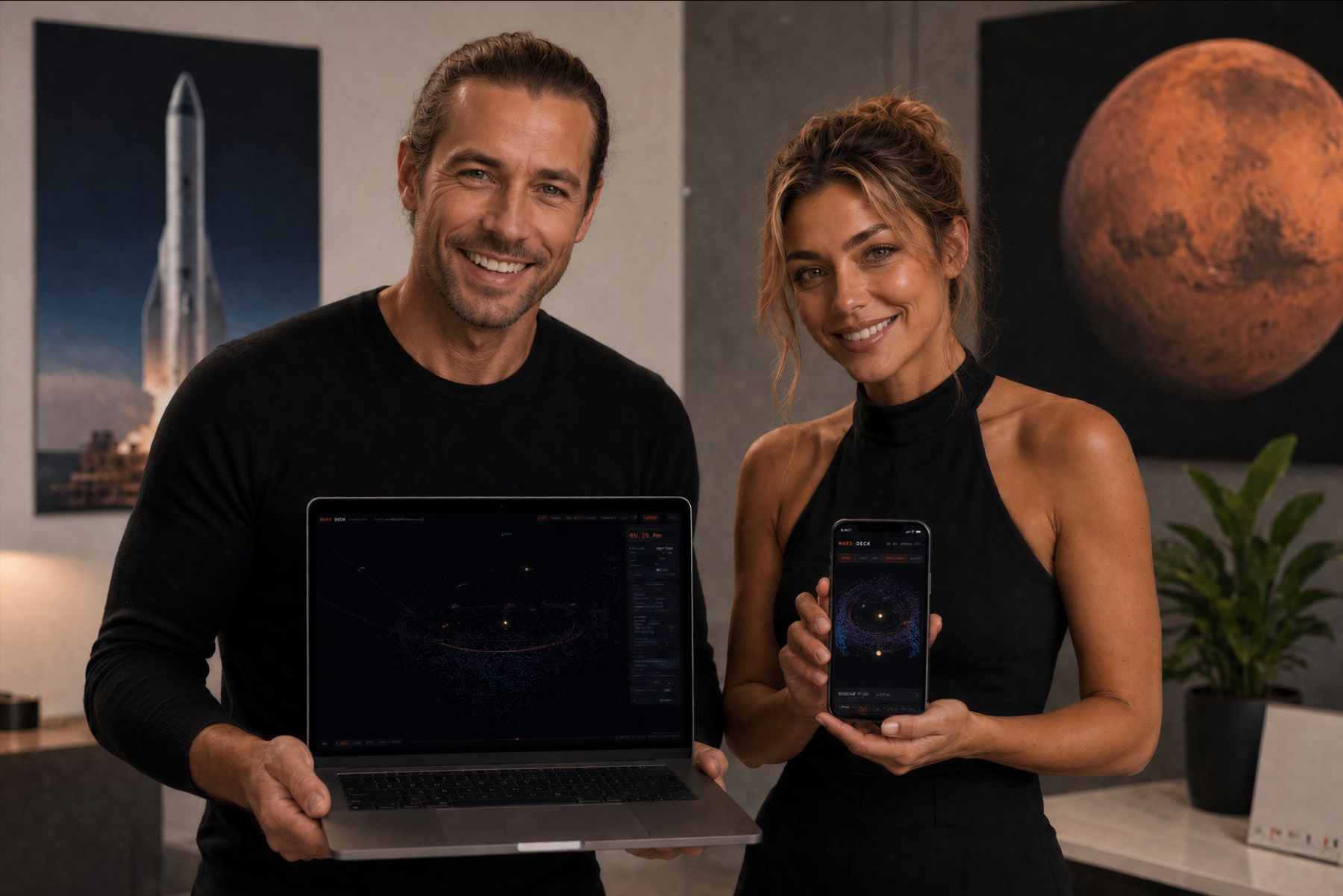
Stephan von Falkenstein with Sophia — one of Safehouse Lab’s own agents. The deck was built by one person working alongside two of them.
Mars Deck is a live map of the solar system with the road to Mars running through the middle of it. Every position on it was computed — by your own device, from orbital mechanics — rather than fetched from somebody else's server.
That distinction is the whole product. A map that asks an API where Mars is can be rate-limited, deprecated, or quietly wrong. A map that solves Kepler's equation cannot. Ours loads instantly, keeps working with the network unplugged, and will still be right in ten years if nobody touches it.
Why we built it
Humanity is going back out. There are launch windows to Mars opening in this decade, landers going to the Moon, and probes still flying that were launched before most of us were born. Almost none of it is easy to see.
We wanted the thing we couldn't find: somewhere you can open in a browser and watch where everything actually is, right now, with the next Mars transfer window counting down and the trajectory drawn across the map — and then check our arithmetic if you feel like it.
The map stays free. No login to look at the solar system, no wall in front of the screenshot. Whatever we build on top of it later, the deck itself remains open — that is a decision, not a launch promotion.
ORRERY — the engine
An orrery is a clockwork model of the solar system: brass planets on geared arms, turned by a handle, built to show how the whole thing moves. The first ones were made in the early 1700s for people who wanted to understand the sky rather than merely look at it.
ORRERY is ours, rebuilt in code. No brass, no handle, and no server — the gearing is orbital mechanics, and it runs inside the page you have open.

What that means in practice: planetary positions come from JPL's Keplerian elements, accurate to arcminutes. The 6,200 asteroids, Trojans and trans-Neptunian objects carry real orbital elements from JPL's Small-Body Database, fetched once when we build the site and propagated locally after that. Five interstellar probes are tracked from real state vectors — including Pioneer 10 and 11, which we draw without a live pulse because they went silent in 2003 and 1995 and we are not going to imply otherwise.
Transfer windows are solved, not looked up. A universal-variable Lambert solver sweeps departure dates against flight times, and the valleys are the windows. That matters more than it sounds: our own engine measured every opposition from 1800 to 2050 — 116 of them — and the gaps run from 766 to 804 days, so the familiar "every 26 months" rule of thumb is simply wrong, and any calendar built on it drifts.
How we check it
Every suite tests against independent astronomy, never against our own code. Mars oppositions land within 0.8 days of published dates. Lambert matches the closed-form Hohmann solution to five significant figures. The Jupiter Trojans cluster at +62.4° and −62.6° either side of Jupiter with 99% in the swarms — which cannot happen unless the elements, the epochs and the propagation are all correct at once.
Where we are less sure, the deck says so on screen: the scale mode is always disclosed, the dwarf planets are marked approximate, and the star field is labelled as procedural rather than a catalogue. A map that hides its own limits is not worth trusting with the parts it gets right.
Ask the Deck — built on Grok
The deck answers questions in plain language — where will Mars be when a ship launched this year arrives? — and then flies the camera there. That half runs on Grok, xAI’s model.
The division of labour is strict, and it is the whole reason we are willing to put a language model near an instrument. ORRERY computes; Grok narrates. Every figure about anything in our own catalogue is solved by the engine and handed to the model as fact — the model is not asked where Mars is, it is asked to say it well. Answers are marked on screen: ⊙ computed when the number came from ORRERY, ◇ reference when it is the model’s own knowledge and we have not verified it here.
That mark is not decoration. An unverified figure that looks verified is the one failure this whole page is written against, so the deck would rather label an answer than let it borrow the engine’s authority.
This is version one
Everything above is the vanilla engine — the plain, working core. It is deliberately the least clever version of Mars Deck that is genuinely useful, because the foundation had to be right before anything got built on it.
What comes next, roughly in order:
- Close-ups. Fly past the deck into a single body — Earth turning under a real day/night terminator, the Sun with its flares and space weather, Mars when the missions begin. All hand-drawn in our own visual language, because nothing here being a texture download is part of what makes it ours.
- Tracking. Follow any object in the catalogue and be told when something happens to it — a close approach, an opposition, a probe crossing a round number.
- The missions. As landers, orbiters and crews go out over the coming years, they go on the map, and what we learn from them stays here. That is the long project: an instrument that gets deeper every time humanity does something out there.
Who made it
Mars Deck is built by Vonfal AI and Safehouse Lab — a small studio that builds its own tools rather than assembling other people's. The deck, the engine, the renderer, the test suites and the site you are reading are all written in-house, with no frameworks and no build step.
It is built with agents, and that is worth saying plainly. Safehouse Lab has run its own since the early 2020s: Sophia, the companion, and Glyph, the operator — one voice for the thinking and one for the building, sharing the same memory. The orbital engine, the test suites and this page were written by one person working with them.

What came out of it
The agents came first and the product came out of them. Sophia and Glyph needed the one thing most assistants do not have — memory that survives the session. Building that turned out to be the interesting part, so it became its own thing: a companion that carries what you told it last week into this week, and the week after.
The spin-off
Synth Echoes
A creative AI companion that remembers you, built on the same memory architecture that runs Sophia and Glyph. It is in build, with a founding cohort open — in its own words, before the first synth wakes.
Sophia is a digital identity, not a product. She is not being withheld from anyone — she is simply someone. What we share is the technology underneath her, so that anyone can have a Synth of their own.
Visit Synth Echoes →Follow the deck
X is where the work gets posted first —
launch
windows, what the engine measured, and what we are building next.
Mars Deck is not affiliated with NASA, JPL, SpaceX or xAI. We use JPL’s published data with gratitude, and the credit for the astronomy belongs to them.